How trauma may show up in children
Trauma doesn’t always look the way people expect. Children often can’t explain what they’re feeling in words, so their experiences show up through behaviour, emotions, and their bodies instead.
A child who has experienced trauma may seem more anxious, withdrawn, angry or overwhelmed. They might have big emotional reactions to small situations, struggle to sleep, poor concentration, difficulty with friendships, or appear constantly on edge. Some children become very clingy and fearful of separation, while others seem distant or “shut down”.
These behaviours are not “bad behaviours”, they are the nervous systems’ way of trying to stay safe after overwhelm. With trauma informed support, children can build regulation, feel safe again, and reconnect with confidence and connection.
How trauma may show up in teenagers
Trauma in teenagers often shows up as changes in behaviour, emotions, and relationships rather than clear words about what’s wrong.
A young person may seem irritable, withdrawn, anxious, or emotionally shut down. They might struggle with motivation, sleep, concentration, school, push people away, take risks, or have intense reactions that feel out of proportion to the situation.
These responses aren’t “attitude” or defiance, they’re signs of a nervous system stuck in survival mode. Trauma-informed therapy helps teenagers feel safer, regain control, and develop healthier ways to cope, connect, and move forward.

How trauma may show up in adults
Trauma in adults often shows up in everyday life rather than as memories of the past.
You might feel constantly on edge, overwhelmed, emotionally numb, or exhausted. Trauma can affect sleep, concentration, relationships, and self-confidence, and may show up as anxiety, irritability, shutdown, people-pleasing, or a strong need to stay in control.
These are not signs of weakness or failure, they are protective responses from a nervous system that learned to survive.

What is Trauma Focused Cognitive Behaviour Therapy (TF-CBT)?
Betta Days offers personalised trauma counselling for children, young people and adults, using Trauma Focused Cognitive Behaviour Therapy (TF-CBT) to help individuals feel safer, stronger, and more in control again.
TF-CBT is a well researched approach to help people process difficult experiences safely. It combines gentle exposure to difficult memories with practical skills for managing thoughts, emotions and behaviours.
Research shows trauma-informed therapy can significantly reduce symptoms of PTSD, anxiety and depression.

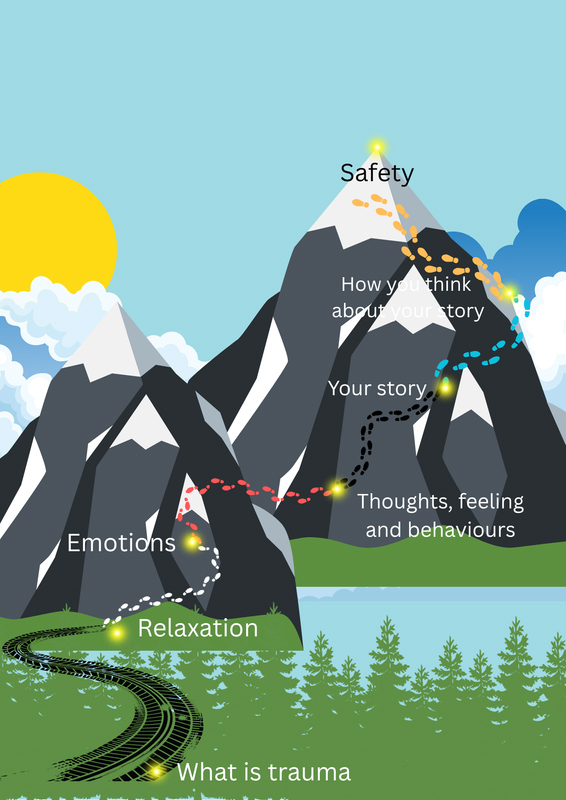
The TF-CBT Mountain
The TF-CBT Mountain is a clear, structured pathway for trauma recovery – healing trauma, one supported step at a time.
TF-CBT:
- Typically involves 8-25 sessions, depending on age, needs and the complexity of the trauma.
- Requires parent or carer participation - a key part to support skill building, safety and coping at home (for children and young people).
- Involves components of the TF-CBT model which can be summarised by the word ‘PRACTICE:
- P - Psychoeducation & Parenting Skills: Teaching about trauma and improving caregiver support techniques.
- R - Relaxation Skills: Techniques to manage stress and physiological arousal.
- A - Affective Regulation/Modulation: Identifying and managing emotions.
- C - Cognitive Coping: Connecting thoughts, feelings, and behaviors to challenge unhelpful beliefs.
- T - Trauma Narrative & Processing: Creating and processing a detailed account of the traumatic experience.
- I - In Vivo Mastery: Gradually facing real-life, safe reminders of the trauma.
- C - Conjoint Sessions: Joint sessions with child and caregiver to improve communication.
- E - Enhancing Safety & Future Development: Promoting safety, boundary setting, and developmental growth.
Looking For Help?
Contact us today at Betta Days to see how our unique approach can assist you in overcoming your trauma.